Bhubaneswar: One of Odisha’s oldest theater groups, Uttara Purusha kicked off its three-day annual theatre festival ‘Nataka Parikrama 2026’ at Rabindra Mandap, Bhubaneswar, on January 27.
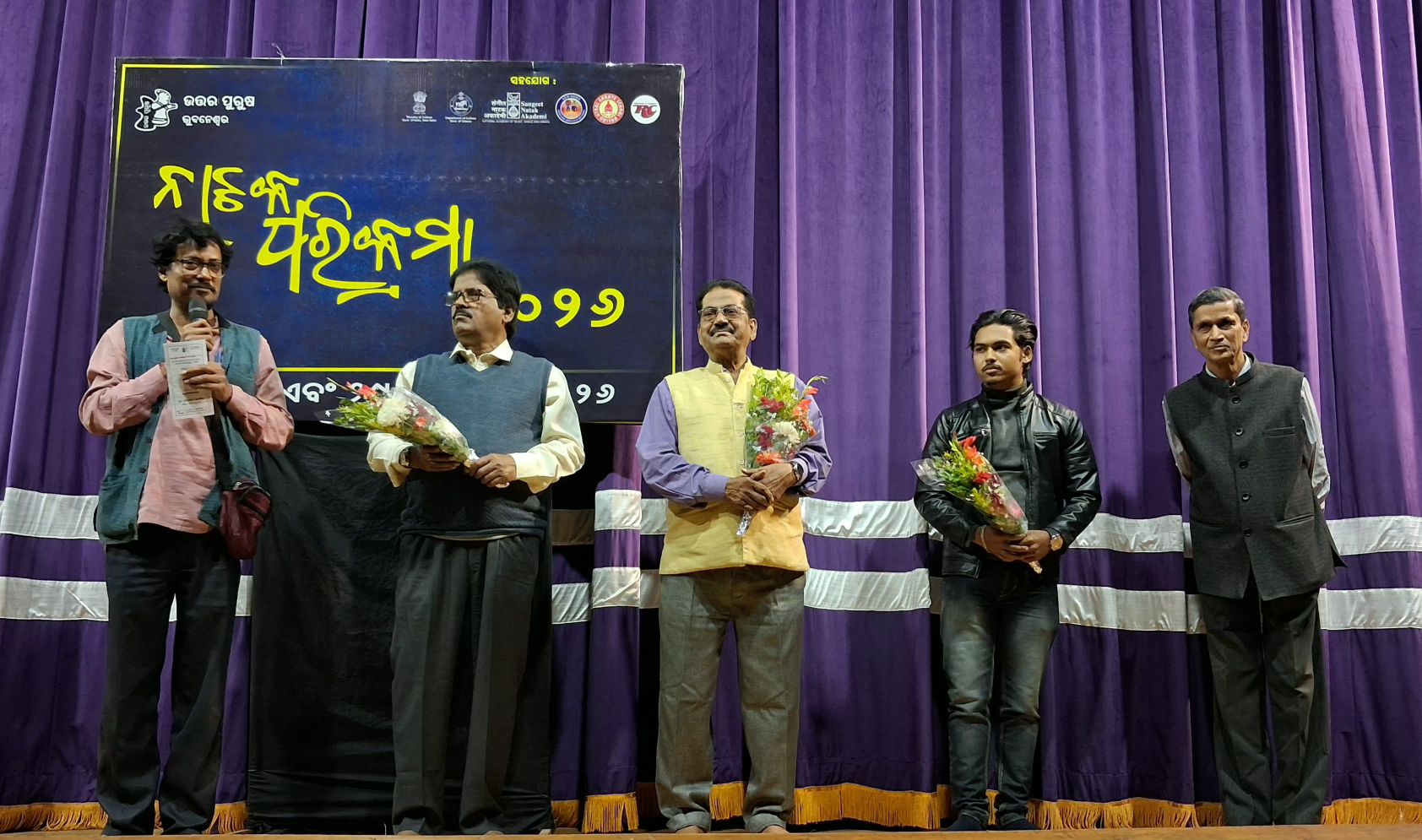
The inaugural evening witnessed the presence of eminent theater personalities Mr Dhirendranath Mallik and Ramakanta Mishra who graced the evening as guests and inaugurated the evening by lighting the auspicious lamp. Uttara Purusha’s secretary Debadatta Pati and president Prasanna Mishra were also present on the dais.
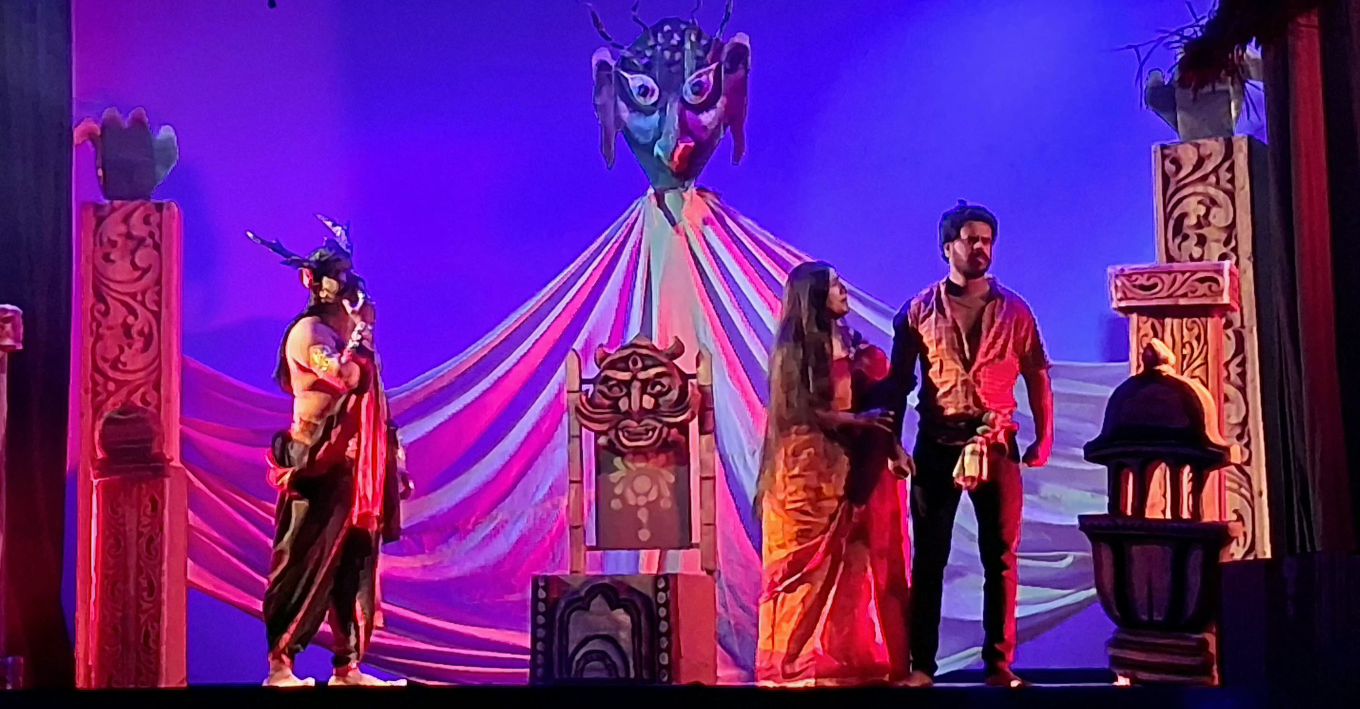
The inaugural play was ‘Adrushta’, written by Mr. Abinash Nayak, an undergraduate student of the Odisha University of Agriculture and Technology (OUAT), and directed by Dr Chakradhar Patra.
The production explores how a human being’s unchecked greed gives birth to six inner vices within him, leading to the downfall of both the individual and society at large.
The play opens in the courtyard of Manua, an eight-year-old boy, where his grandmother narrates a tale to lull him to sleep. Her story—set three centuries ago—gradually unfolds into a haunting legend rooted in the village’s past. She recounts how the wife of the village head transforms herself into a spiritual being through ‘tantra sadhana’. Her servitor, slowly consumed by greed, begins by stealing trifles and soon escalates to coveting precious possessions. His growing lust for his mistress seals his fate—she curses him to become a Yaksha, a supernatural being. Renouncing the palace, she retreats to the outskirts of the village, taking shelter beneath a solitary tree.
As she narrates, the entire story simultaneously unfolds at the upstage centre, seamlessly weaving past and present, coaxing the theatre lovers to get involved in the flow of the story.
Twenty years later, Manua is now a grown man, who hardly does anything to run his family that comprises of his grandmother and his wife Rupa. Though his father is alive, but he never lives with them.
One day, he has a chance encounter with the Yaksha in his palace located at the top of the hill in the jungle. Seeking liberation from the old curse, the Yaksha uses Manua as a pawn. By tempting him with wealth, riches, and gold coins, the Yaksha slowly ensnares Manua and gets his own sinister deeds carried out through him.
Blinded by greed, Manua loses all sense of right and wrong. He becomes a slave to desire and runs endlessly after a mirage, never pausing to judge his actions. Anyone who comes in his way is destroyed—he no longer distinguishes between his own and others. Ultimately, this ruthless pursuit ends in tragedy, with the death of his own loved ones. He even offers his wife who is pregnant four years after the marriage to the Yaksha to become the richest person of the village.
Then, a moment of reckoning dawns upon him. Seeking redemption, he turns to his estranged father for help in freeing Rupa from the Yaksha’s clutches.
At this point, the narrative takes a startling turn. It is revealed that prior to him, Manua’s father had once struck a similar bargain with the Yaksha. He had sacrificed his own wife for riches and inherited the Yaksha’s traits in return.
From here onwards, suspense tightens its grip, leaving the audience grappling with unsettling questions. To know what happens with Manua, the Yaksha and his father in the end, you have to watch the play yourself.
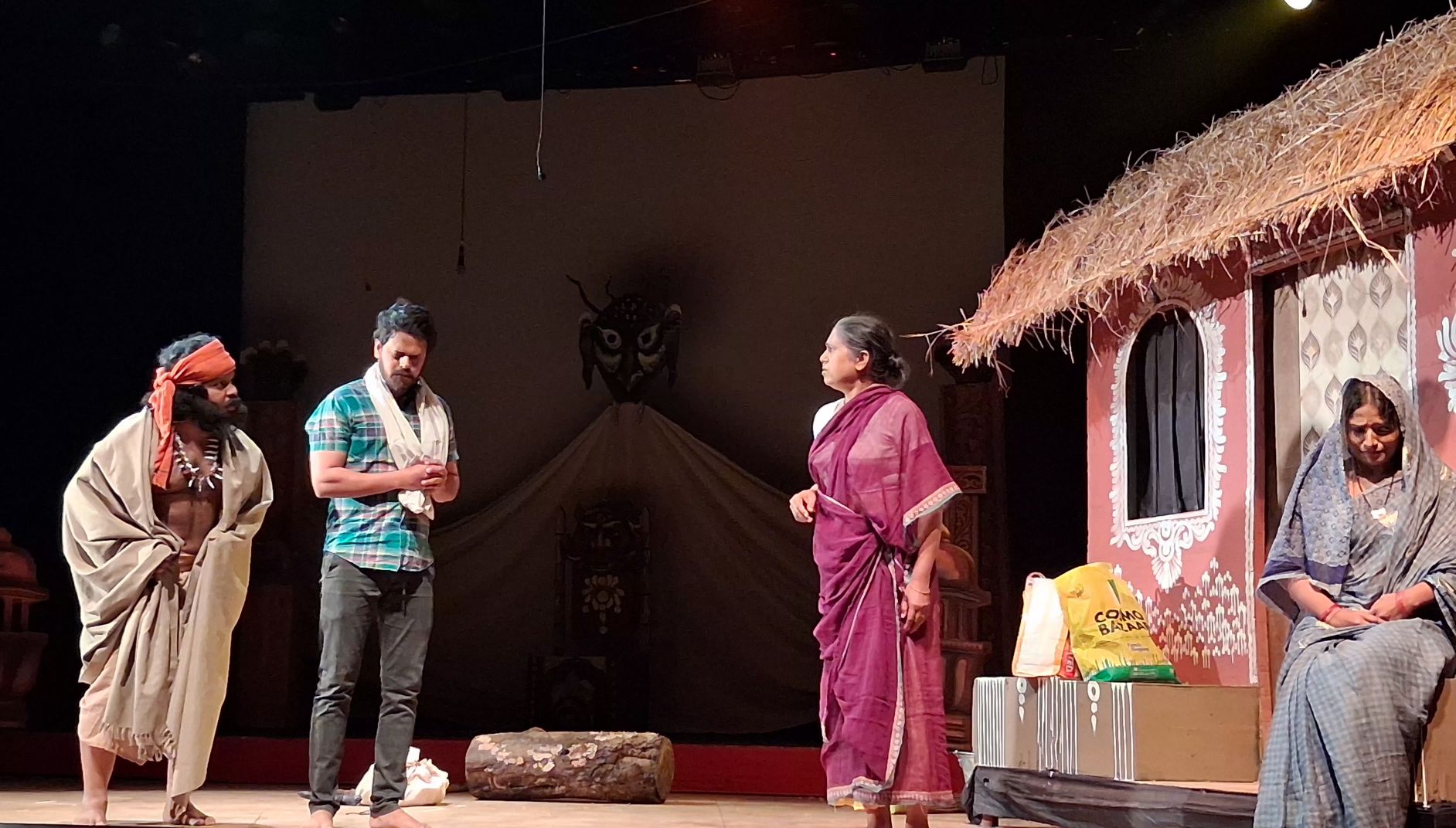
After a slightly slow start in the initial few scenes, the play gathers space, leaving the theatre lovers glued to their seats. While all actors delivered earnest performances, Dr Chakradhara Patra as Yaksha, Pranati Mallik as grandmother, Ranesh Kumar Patang as Manua, Nishikanta Nayak as Manua’s father, Pragati as Rupa and Rupesh as Manua’s friend Benu stood out.
Dr Kailash Senapati, Rakesh Satpathy and Mama Chitralaya were in charge of music, light design and costume. Music, lighting, and costume design were handled by Dr Kailash Senapati, Rakesh Satpathy, and Mama Chitralaya, respectively. However, the storytelling, lighting design, and musical transitions need a little refinement to elevate the production.
With this play, Uttara Purusha once again lives up to its legacy of bringing young talents to the fore. In 2017, the late theatre stalwart Asim Basu, one of the group’s co-founders, had given Chakradhar Patra, then an OUAT student an opportunity to direct ‘Hathi O Lanthan’. This time, the spotlight falls on young playwright Mr. Abinash Nayak, a student of the same OUAT.
Uttara Purusha, as I mentioned earlier that it is one of the oldest theatre groups, was founded in 1970 by some likeminded people like Asim Basu, late Raicharan Dash, late Gourishyam Mohapatra and Banchhanidhi Pattnaik and has remained a vibrant force in Odisha’s theatre scene.
It has since been active with theatrical activities like organizing theatre workshops, festivals and participating in theatre festivals across the country.