Bhubaneswar: Odisha has no shortage of theatre groups that bring nationally celebrated playwrights’ plays to local audiences, and Jeevan Rekha Theatre Group, a Bhubaneswar-based theatre group, stands tall among them.
It is worth mentioning that to be mentioned here that Jeevan Rekha is known for roping in a large number of young actors, which is why it naturally draws a crowd where youth form the lion’s share of the audience.
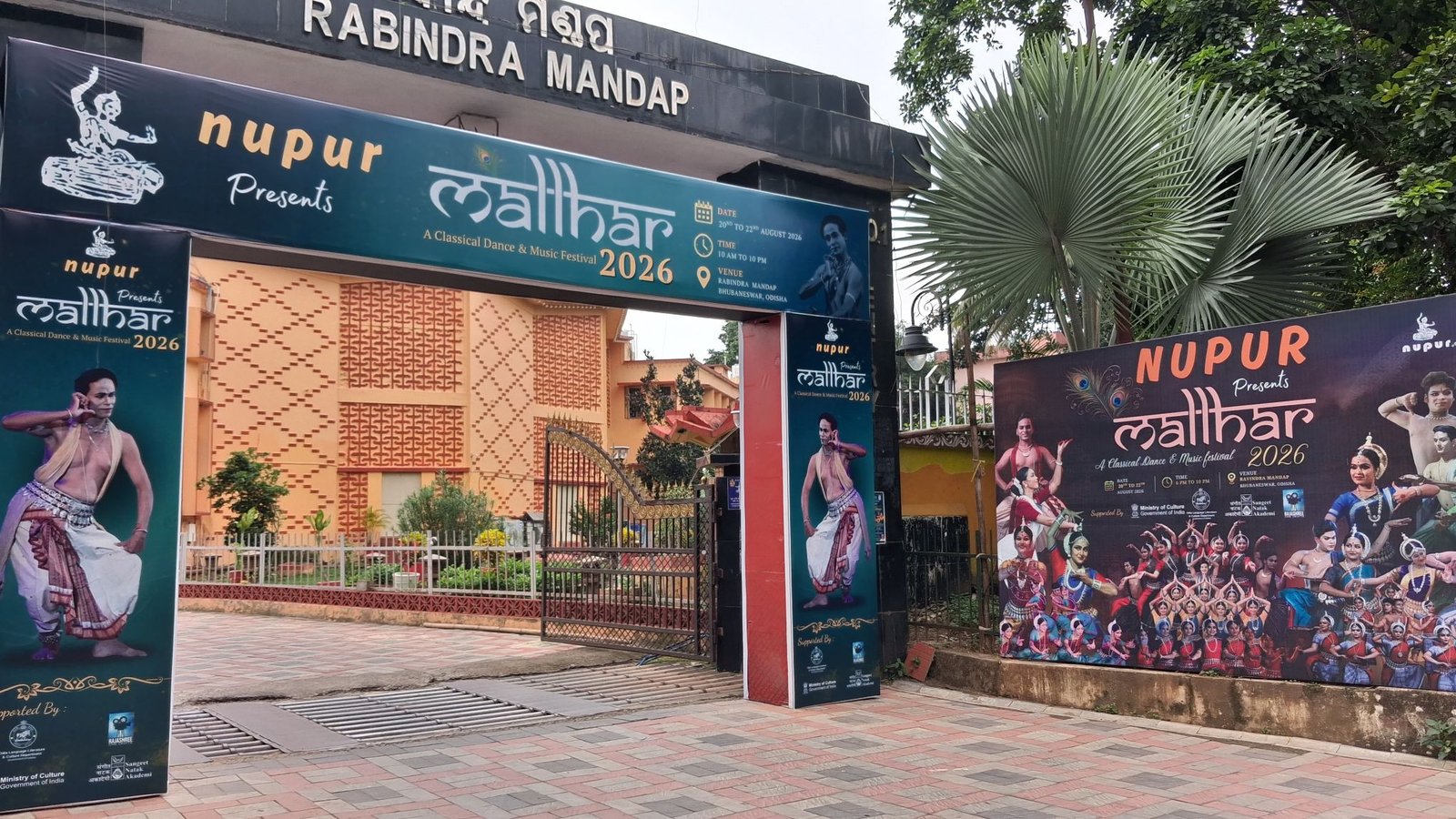
The group recently hosted a three-day theatre festival ‘Ranga Utsav’, at Rabindra Mandap here, starting April 23, featuring three Odia plays- ‘Crime and Punishment’ (April 23), ‘Anamika Tara’ (April 24) and ‘Andha Yug’ (April 25).
I had to give the first two a miss due to prior commitments, but I did manage to catch the final act—and it was well worth it. From what I gathered in conversations with friends and fellow theatre-goers, the earlier performances had already struck the right chord.
‘Andha Yug’ also didn’t let me down.
Written in Hindi by famous novelist, playwright and poet Dr Dharamvir Bharati (1926-1997) and translated into Odia by Soudamini Nanda, this verse play, written in the aftermath of India-Pakistan partition, zooms in on the 18th or last day of Kurukshetra war.
While most are familiar with the broad strokes of that fateful day, the play breathes fresh life into the narrative.
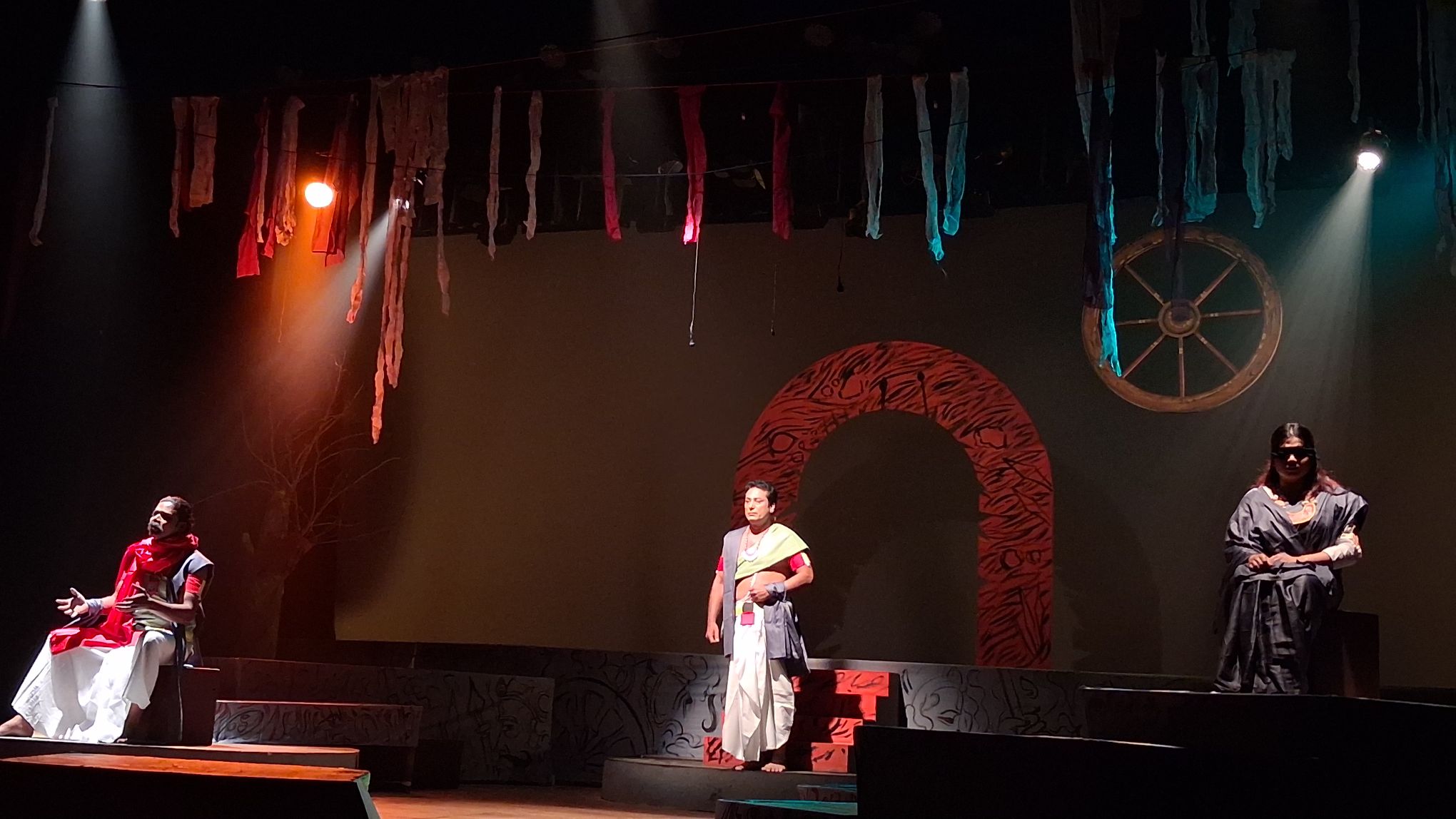
After the death of Duryodhana at the hands of the Pandavas, Aswatthama vows to take revenge of his father’s killing. He launches a midnight attack and kills the Pandavas’ five sons. Not stopping there, he releases his ultimate weapon, the Brahmastra. Realizing the consequences of the weapon, Byasadev requests him to rein it in, but the weapon can’t be recalled and hits Uttara’s womb, killing the foetus of Parikshit. Reinjecting life into the dead foetus, Lord Krishna curses Aswatthama that he will move around with a decaying body.
Meanwhile, Gandhari along with Dhritarastra, Bidur and Sanjay comes to the battle ground only to be confronted with the grim remains of Duryodhana. In her grief, she blames Lord Krishna for the devastating war and the death of her hundred sons.
But, Lord Krishna is not to be blamed for the devastation. It is Dhritarashtra who is entirely responsible. He is physically blind, yet his deeper moral blindness casts a long shadow of darkness over the entire age.
To me, the play’s message is loud and clear. It is we, the human beings, who easily blame the God for whatever bad happens to us. But we forget it that whatever good or bad we are experiencing is due to our past actions.
The play also drives home a hard truth—war breeds nothing but destruction; peace remains a distant dream.
Though written in post-partition time, the play still rings true in the present context of ongoing war between several countries, underlying that nothing but destruction is achieved by war.
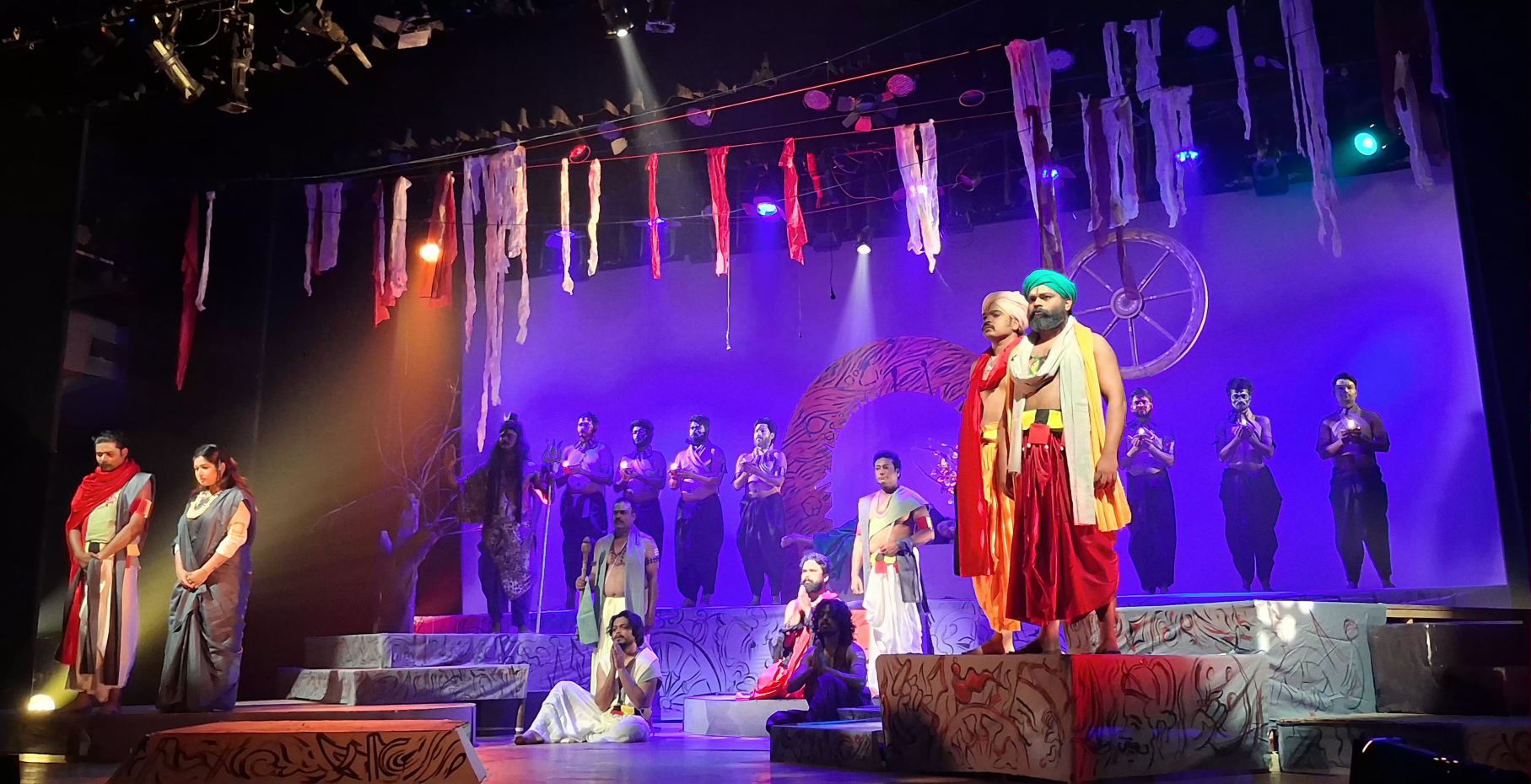
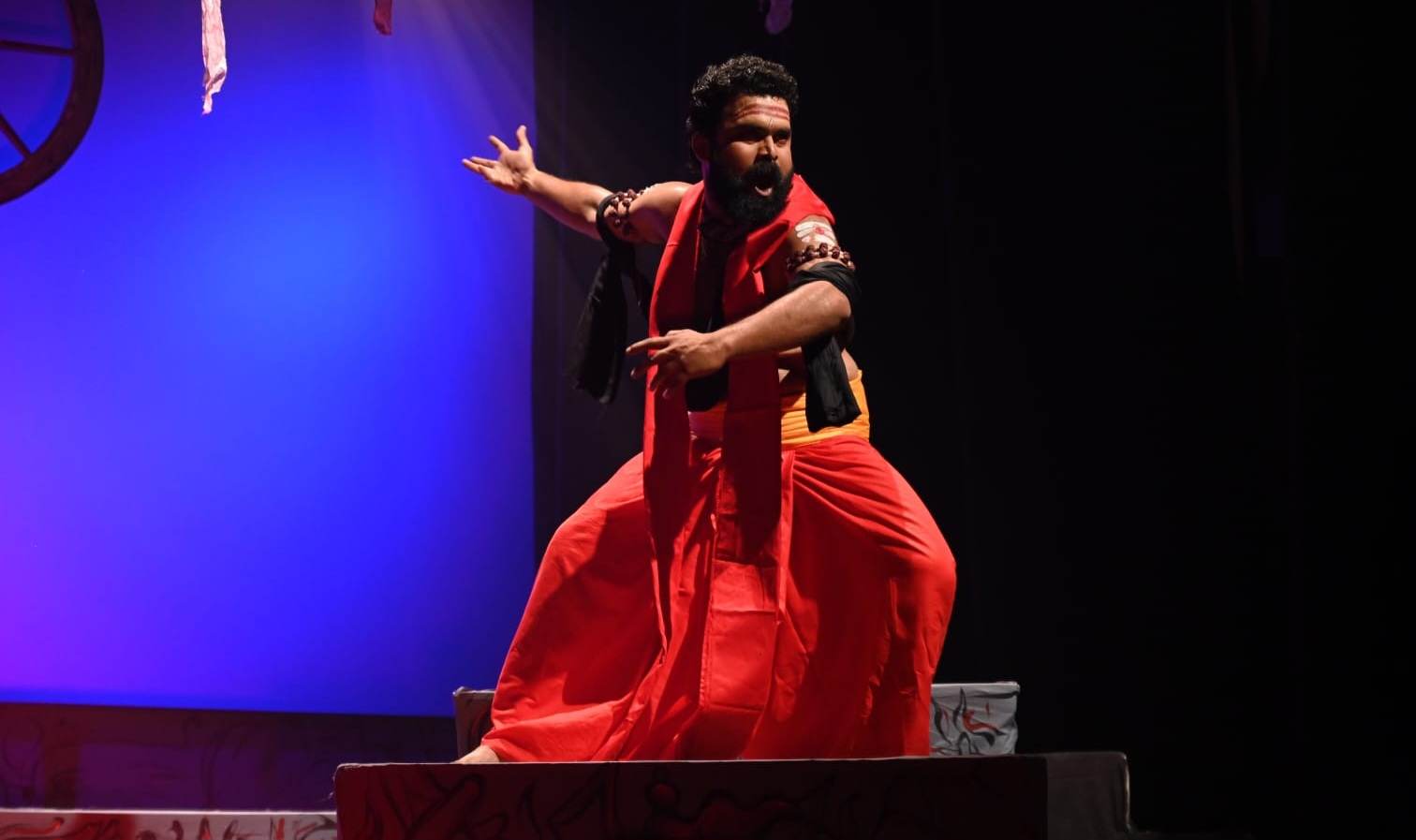
Director Abhinna Routray deserves a pat on the back for presenting the play through a layered psycho-physical approach, enabling actors to get into the skin of their characters. The cast too stood up to the expectations, with standout performances by Dipanwita Dasmohapatra (Ashwatthama), Srinivas Reddy (Dhritarashtra), Tapan Mohanty (Bidur) and Ashish Rout (Sanjay).
That said, a few dialogues were not clearly audible at times. Hope this could be rectified in the next productions.
The choice to dress actors in non-mythological costumes even though the plot is purely mythological, was a clever move, subtly tying the narrative to the present day.
I didn’t find the stage design as that impressive. However, thumbs up for the director to symbolically use a dead tree at one end of the stage to suggest the barrenness of war and a suspended wheel to signify the relentless march of time was a nice touch.
The light design was ok but the designer has to be a little bit more attentive.
All things considered, the production was a compelling watch—engaging from start to finish. Kudos to the entire team for pulling it off with finesse.
On stage: Dipanwit Dasmohapatra, Sheetal Pattanayak, Shreenibas, Ashish Rout, Sant5osh Mohapatra, Tapan Mohanty, Ashutosh Panda, Siddhi Ranjan, Jayshankar Mishra, Jugal Sahu, Rohan Yadav, Trupti Ranjan, Sagar Mohapatra, Gorekhnath Sankhua, Priyajeet Behera, Jyoti Ranjan, Biranchi Samantaray, Biswambar Dash, Chandan Behera, Ashish Kumar, Rudra Madhav, Kabita and Pratiksha
Off stage: Ashok Kar (Production Manager), Satya Ranjan Nandi & Chandan Vedula (Stage Coordinators), Bibhas Rath (Music), Jugal Sahu (Choreography), Sanjay Saha (Stage and Light Design), Santosh Lenka (Special Music Arrangements)